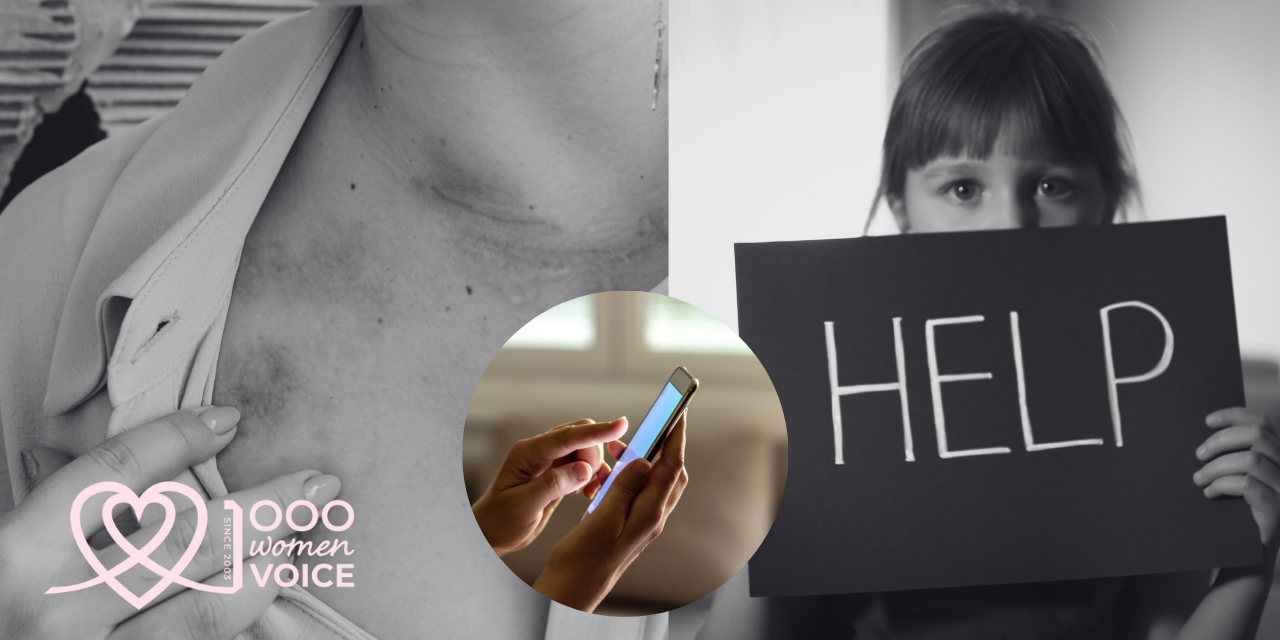
Lack of technology, abuse by communities main challenges discussed at #HearMeToo-sessions

Karen Painter • 5 May 2021

CAPE TOWN. – A lack of basic technology, the total absence of empathetic support by community members, the depiction of men as the head and of the woman as the neck, and the economic dependency of women on men as breadwinners dominated many discussions at the #HearMeToo -sessions of 1000 Women Trust the past month.

Late in 2020, 1000 Women Trust joined a network of organizations led by the Nottingham School of Business as they embarked on a campaign to explore digital technology and the role it might play to address gender-based violence in South Africa. The campaign is called WE DARE , acronym for Women’s Equality: Digital Access and the Right to Expression.

The WE DARE project is led by Professor Mollie Painter and the Nottingham Business School team.

1000 Women Trust is a network partner of the Nottingham Business School and ran 40 community focus groups and #HearMeToo -sessions to ascertain what the barriers are for women to use existing technology in addressing gender-based violence in the communities.

The 1000 Women Trust is a women’s organisation that aims to raise awareness around gender-based violence, rape and abuse and mobilises resources to empower and inspire women who are victims of gender-based violence.

Women from vulnerable communities that formed part of the focus groups of 1000 Women Trust, mainly use Whatsapp to access support and connect with others for issues around gender-based violence. A very small proportion of the women reported using an app, and a majority didn’t use technology at all and had not heard of the any of the helplines that have been advertised online. A small handful of the women used the internet, said Tina Thiart, trustee of 1000 Women Trust.

Phoshollo Phasha, facilitator of #HearMeToo-sessions in the Burgersfort-area in Limpopo, is a small-business entrepreneur who also sells branded clothing called W.O.R.M.S (Work Out Realistic Magical Success).

Phasha conducted two #HearMeToo-sessions, with 25 attendants on one occasion and 50 at her last session.

She discussed gender-based violence with the women and the youths.

The women and the youths readily shared their own stories of being subjected to violence, and how they are recovering after the assaults.

She detected multiple challenges that the survivors face when dealing with domestic violence.

Many of the women were unaware of the fact that there was a shelter in the area where they could receive help.

They did not know of an app on the cell phone called Siza with which they could share their exact location when they are endangered.

At the #HearMeToo-sessions, they were also told about hotlines and emergency numbers that they can call in order to receive assistance. They did not know about these numbers beforehand.

Phasha pointed to the fact that most of the youths and the women simply did not have cell phones, or there might not be a signal in their area, or they did not have enough data or airtime when it was needed to report a crime committed against them.

That is due to the high rate of unemployment in the Burgersfort-area, she said.

Another factor is the pressure by the communities and families on women who are survivors of gender-based violence.

“Many women grow up with family members telling them that men are the head and that women are the neck, which means you cannot do anything without using the head.

“When women who are sexually abused by an uncle, want to report it, they are told that they might ruin the family, or taint the family name, and that they should not do it,” Phasha explained.

“So many women are told just to keep quiet.

“They also feel intimidated when they approach a court which is headed by men.”

A lack of motivation by women to study and finish their school career, also undermines their well-being.

It happens that young women are told not to study after school, because they are told they don’t need it. There are many mines around the area, and young women reason that they can marry and have children and their husbands will look after them and provide for them.

Because of this economical dependence, they are often stuck in abusive relationships with men who provide financially, but don’t care about their well-being.

There are cases of teens of 16 years of age who marries older men who provide for them, and they simply tolerate the abuse, said Phasha.

Recently, her own computer was stolen, and she hopes to replace it and start an internet café as an empowerment hub for young job-seekers in order for them to get out of the spiral of gender-based violence.

Davina Cloete conducted two #HearMeToo-sessions at Lutzville which was attended by 45 women and youths.

Gender-based violence in the area of Lutzville is rampant and it is incredibly challenging for survivors of the abuse to successfully seek assistance.

Almost no-one amongst survivors have a cell phone as most are seasonal workers labouring on farms whose primary focus is to buy food to survive.

But when they try and report gender-based violence, they are perennially told by police that they need to acquire an interdict against their husband or boyfriend.

Or they are turned away by police who verbally abuse them by telling them that they smell or that they are “old maids”, Cloete said.

In most of the cases that make it to court, there are no or little prosecution of the alleged perpetrators.

The community sometimes exacerbates the problem, because they will abuse the woman who reports sexual abuse.

“A few Saturdays ago, a girl of 15 years or age was raped, and some of the women in the community shouted at her, asking her why she had been drinking,” Cloete said.

Such is the magnitude of gender-based violence and sexual abuse that the government appointed Advocate Lesley Morris to investigate the matter, but Cloete said she really struggled to get hold of him, and he is nowhere to be seen.

Five women were the victims of femicide during the lockdown, another example of the challenges faced by people in the Lutzville- and Vredendal-area.

Because they don’t have access to technology due to economic constraints, women have to travel about 25 km between Lutzville and Vredendal to report a case of sexual abuse and other forms of gender-based violence to the police. But they have to pay R80 for a taxi-ride in order to report the case.

Ultimately, many women who struggle financially, find themselves locked up in an abusive relationship with a man and almost every weekend, scores of them are beaten up, with little chance of their abuse being reported successfully to a police station, Cloete added.

Jasmina Samuels facilitated three #HearMeToo-sessions in Saldana and discussed all forms of gender-based violence with the attendants.

They spoke at length about domestic violence, rape, gender equality, the parent-child-relationship, abuse of senior citizens, and alcohol abuse.

“Gender-based violence is a massive problem, because many women are abused by their husbands and do not report the violence because they don’t work and are dependent on their husbands or partners. And unemployment is a big challenge in the community,” Samuels says.

Generally, the women who are abused don’t have access to cell phones or any other technological devices, simply because they don’t have the means to buy phones.

So they either contacted the police or visited her to complain about the domestic violence.

She had many, many cases of women who woke her up in the middle of the night, and then she physically went to the home of the abuser afterwards and spoke to him about the assault on his wife. Because she is a co-pastor of the House of David-church and is widely respected, her words had an impact on the men and they were willing to change their violent ways.

But due to the COVID 19 pandemic and the restrictions on movements, she had less women contacting her in 2020 and 2021, Samuels said.

Vanessa Nelson is the founder of the NPO Hope for the Future that is affiliated to 1000 Women Trust.

Nelson facilitated two #HearMeToo-sessions in Heideveld in April 2021. Both of these sessions were intense, emotional and ran for almost five hours each.

“We created a safe space where women could share their stories of being survivors of gender-based violence and almost 99 % of them suffered physical, emotional, psychological and economical abuse.

“In the Heideveld-area this domestic abuse in all its forms are rampant.

“What was evident during the sessions, were that at least 60 % of the attendants did not have the cell phones or any form of technology to report their abuse,” Nelson said.

As chairperson of the Heideveld residential association she liaises with police on a platform once a month, and this improves the ability of abused women to report gender-based violence to the police.

The demand for regular #HearMeToo-sessions in Heideveld and Blikkiesdorp are so high that she needs to conduct sessions twice a month in the future.

The reason for the gender-based violence is an attitude prevalent amongst men that women belong to them and are their possession and that they can do with women what they want, Nelson said.

She advocates the importance during the sessions that women are independent and have a voice.

“I tell them that they are bold and must speak out, tell their stories and count on the support of other women,” Nelson said.

She also shares her own story of abuse during the #HearMeToo-sessions to serve as an inspiration to other women.

She said her recovery from gender-based violence perpetrated by her second husband started when she share her own story on Facebook in 2018. Her husband learned about this and was annoyed and turned to heavy drinking. He also attacked her verbally.

But when the second pandemic of gender-based violence went viral on social media and on TV in 2019, she confronted her husband and told him that he is part of the statistics of people who are perpetrators of gender-based violence.

She also told him that she loved him, but that his violence are pushing his family away.

He was never willing to admit that he was a problem and was a narcissist who always said she was guilty.

Because of that confrontation in which she exposed him as a statistic perpetrating violence, he was stunned and he changed his ways.

His mind-set was transformed, and he has stopped all forms of abuse.

“My marriage is in a new space, and we never thought we would be this happy,” she said.

Nelson is also inspiring other women to become independent and to share their stories of survival and being overcomers.

One of these women is her sister, who was subjected to domestic violence for 24 years.

Her next challenge is to find a venue in Heideveld to organize #HearMeToo-sessions for about 60 young women who are in need of counselling, she said.

For more information, visit  www.1000women.co.zawww.bullying.co.za  or  www.maketime.org.za

If you wish to contact 1000 Women Trust, phone 0614690479
by Lauren Zinn 20 April 2026
— and South Africa cannot afford to look away
by Karen Specter 24 February 2026
1000 Women Trust: an open invitation to invest CSI-funds and empower SA women 1000 Women Trust has become a premier change agent in South Africa in empowering women and breaking cycles of violence through its transformative Project Orange, its chatbot-initiative and its Talking to Boys-incentives. Now this non-profit organization, working to advance gender equality, is inviting South African companies with CSI-funds (Corporate Social Investment) to partner with the Trust to increase its footprint – its life-changing impact on communities in all nine provinces. “By investing your CSI-funds in our Project Orange, our GBV-Warriors and our Chatbot-Initiative, you can receive a 18 A certificate and save tax, while simultaneously helping 1000 Women Trust to fulfil its twin mission – the eventual eradication of gender-based violence while transforming women into inspirational community and business leaders,” said Tina Thiart, co-founder and trustee of 1000 Women Trust. “As public benefit organization, 1000 Women Trust can issue that section 18 A tax certificate for qualifying donations, allowing your contribution to make both a social and financial impact,” Thiart added. The Trust has embarked on multiple campaigns the past 24 years, benefitting tens of thousands of SA women and we can show our impact. Included please find our Fact Sheet and legal information. For more information visit www.1000women.co.za 1000 Women Trust is a South Africa–based non-profit organisation working to advance gender equality and prevent gender-based violence through education, empowerment, access to resources, and collective action. For media enquiries and further information: Communications Office 1000 Women Trust. Email: info@1000women.co.za Phone: 061 469 0479 Website: https://1000women.co.za .
by Karen Specter 29 January 2026
Chatbot-initiative ‘a game-changer for women trapped in abusive relationships’ The women-led organization 1000 Women Trust has launched a Chatbot-initiative to provide a 24-hour service to women and children, an intervention set to become a new benchmark for South African organizations working with survivors of gender-based violence. “We developed and completed the Chatbot Initiative, a 24-hour WhatsApp technology-based tool which women and children can access support and educational resources at any point in time on their mobile devices,” said Tina Thiart, co-founder and trustee of 1000 Women Trust. “The real advantage of a tool like the 1000 Women Chatbot lies in how it bridges gaps for women who previously had no access to structured, immediate, and safe guidance,” Thiart said. “Many women in rural or underserved communities may not have access to shelters, councillors, or legal aid. A chatbot can provide instant information via a mobile phone, which is often more accessible than in‑person services. “Unlike human services limited by office hours, the chatbot is always on, offering support at any time of crisis or need. This is why 1000 Women Trust’s Chatbot-initiative is set to be a game changer for the industry,” Thiart said. “The Chatbot-initiative is set to be a lifesaver for women trapped in abusive relationships,” said Bianca Charles, office manager of 1000 Women Trust. “A woman or girl in distress of need can be offered immediate relief as the Chatbot provides a comprehensive database of helplines and centres for immediate assistance,” says Charles. “The Chatbot-initiative offers women access to trauma training and anti-bullying material developed by 1000 Women Trust. It also provides potential lifesaving information like how to get a protection order as well as legislation about women’s rights,” said Charles. “In the first quarter of 2025, the official crime statistics revealed that 10688 rape cases were recorded, while the number of sexual offences totalled 13453. A Human Science Research Council study revealed recently that 7.3 million of SA women were subjected to physical violence in their lifetime. Therefore, the Chatbot-technology is critical,” Charles emphasized. “Unlike human services limited by office hours, the chatbot is always on, offering support at any time of crisis or need,” Charles said. Traditional campaigns often focus on raising awareness, but the chatbot provides immediate, actionable guidance — safety planning, and access to resources, Charles added. “In essence, the chatbot initiative sets a new standard by bridging the gap between awareness and empowerment. It shows that organizations can go beyond telling women “GBV is wrong” to actually helping them escape, rebuild, and thrive,” Charles said. The chatbot-initiative can become an invaluable research ally in the fight against the scourge of GBV, according to Charles. “Anonymized usage data can help organizations understand patterns – like what women ask most, where gips in service delivery exist and which resources are most needed. This evidence-based feedback can allow NGO’s and policy makers to refine strategies in real time,” Charles said. The initiative is the product of a four-month research, development and refinement phase by the Trust and their technology partners. The Chatbot offers 24/7 guidance and safe information, is accessible to all communities and will include stories of hope and resilience as well as training on rights and resources, says Thiart. On WhatsApp, it’s free, fast, and always there when you need it. How to Register 1️⃣ Save 087 373 1585 as a WhatsApp contact 2️⃣ Send “hi” 3️⃣ The chatbot will invite you to complete a sign-up form 1000 Women Trust is a South African non-profit organization dedicated to combating gender-based violence (GBV) and femicide through advocacy, education, and, skill-building. For over 20 years, it has empowered women, trained over 10,000 trauma councilors, and supported community projects to power, inspire and empower women. For more information, visit the Trust’s website on 1000women.co.za or phone (061) 4690479.
by Karen Specter 25 January 2026
1000 Women Trust trauma support training launched on 26 th January 1000 Women Trust has announced the launch of the trauma support training via the 1000 women 1 Voice Chatbot, on Monday 26 th January 2026. The trauma support training is a pivotal part of 1000 Women Trust’s work and has empowered and inspired communities throughout South Africa since its inception. The 1000 Women 1 Voice Chatbot aims to create a highly accessible and safe digital tool for providing information on Gender-Based Violence (GBV), trauma support, and confidence-building skills, said Tina Thiart, co-founder and trustee of 1000 Women Trust. How to register 1️⃣ Save 087 373 1585 as a WhatsApp contact 2️⃣ Send “hi” 3️⃣ The chatbot will invite you to complete a sign-up form Once registered, you’ll be able to: • Access trauma support training courses • Explore resources and helplines • Build confidence and skills • Participate in meaningful research to drive action for women The 1000 Women Trust is a South African Women's Rights Organisation dedicated to combating gender-based violence and femicide (GBVF). For over two decades, we've been empowering GBV Community Organisations nationwide, advocating for change and resilience. At 1000 Women, we stand with survivors and the organisations supporting them. We believe in equipping women with knowledge, skills, and resources to chart their own paths towards solutions. Our efforts aim to inspire, educate, and empower women, driving towards gender equality in our communities. For more information about the trauma support training, contact our office on 0614690479 or info@1000women.co.za_ fo@1000women.co.za .
by Karen Specter 24 January 2026
Upcoming launch of the 1000 Women Trust chatbot The 1000 Women Trust is thrilled to announce the launch of our new chatbot, a powerful digital tool created to advance our mission of Inspire, Educate, Empower, and Equip women and children, said Bianca Charles, office manager of 1000 Women Trust. This innovative platform is designed to raise awareness about Gender-Based Violence (GBV) and femicide, while offering practical support and resources to communities across South Africa, Charles added. Through the chatbot, we will: Inspire through stories of hope, resilience, and courage. Educate and Empower through training courses and education about GBV laws and procedures. Equip women and children with the skills and resources to support their communities. The chatbot will be a WhatsApp technology-based tool, making it the most accessible platform for communication and learning. With its 24-hour service, women and children can access support and educational resources at any point in time, ensuring help and guidance are always within reach, Charles said. The launch of this chatbot marks a bold step forward in harnessing technology for social good. By combining innovation with compassion, we are creating a safe, accessible space where women and children can find guidance, strength, and solidarity, Charles explained. 1000 Women Trust is a South African Women's Rights Organisation dedicated to combating gender-based violence and femicide (GBVF). For over two decades, we've been empowering GBV Community Organisations nationwide, advocating for change and resilience. South Africa grapples with alarming GBV statistics. At 1000 Women Trust, we stand with survivors and the organisations supporting them. We believe in equipping women with knowledge, skills, and resources to chart their own paths towards solutions. Our efforts aim to inspire, educate, and empower women, driving towards gender equality in our communities. For more information, contact the Trust on 0614690479 or email us on info@1000women.co.za .
by Karen Specter 1 January 2026
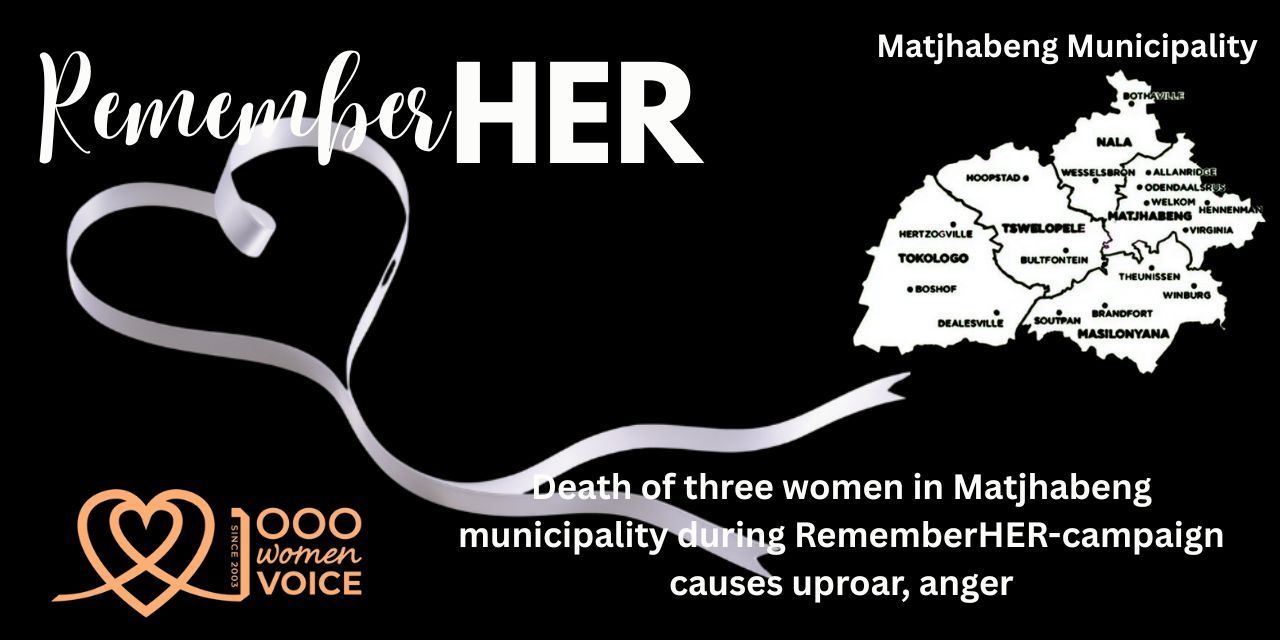
Death of three women in Matjhabeng municipality during RememberHER-campaign causes uproar, anger The gender-based violence related murders of three women from the Matjhabeng local municipality during 16 days of activism against GBV and femicide, has caused an uproar in the Free State just days before a RememberHer-meeting in Welkom. The woman-led organization 1000 Women Trust launched RememberHER, a nationwide mobilization to honour the women and children whose lives were lost through gender-based violence, as part of the global 16 Days of Activism against Gender-Based Violence and femicide. “Through storytelling, remembrance, and collective healing, we invite all women’s organisations nationwide to join hands with us by creating “memory corners” – sacred spaces where communities can gather, reflect, and heal,” said Tina Thiart, co-founder of 1000 Women Trust, when announcing the RememberHER-initiative. The death of Mpho Gladys Nkhobo (46), stabbed to death by her husband in the Matjhabeng local Municipality, has rocked the communities. Glenda Roberts (61), an experienced social worker at the Welkom-office of the Lejwelaputsai-district, was mugged and stabbed to death on her way to work in the morning. And Masesi Merriam Saudi from Thabong, also in the Matjabeng local municipality, was murdered. Sy was on her way to work when she went missing. Says Cynthia Khumalo, a GBV-Warrior and ambassador of 1000 Women Trust: “The Bothaville, Henneman, Odendaalsrus, Welkom and Bultfontein areas are hot spots of gender-based violence and femicide in the Lejweleputswa district.” With regards to rape and sexual offences, the Free State recorded the second highest rape ratio in the country (24.4 %), with significant increases in sexual assaults in some quarters. “We mourn the senseless killings of three innocent women,” said Thiart. “GBVF has just been declared a national disaster. It is pivotal that the South African Police Force (SAPF) act swiftly and decisively to arrest the murderers of these women and that justice is served without delay,” said Thiart. “We need to send the right message to the communities about GBVF,” she added. Thiart said one of the objectives of RememberHER during 16 days of activism is to honour the women who lost their lives through GBV. The scale of GBV is horrific is shocking. Between April 2023 and March 2024, 5,578 women were murdered in South Africa. In just the first quarter of 2025, the country lost 837 women through femicide. That translates to roughly nine women killed every single day. 1000 Women Trust is a South African Women's Rights Organisation dedicated to combating gender-based violence and femicide (GBVF). For over two decades, we've been empowering GBV Community Organisations nationwide, advocating for change and resilience. For more information, contact 1000 Women Trust on (061)4690479.
by Karen Specter 1 January 2026
Beyond 16 Days launched to expose ‘weakest links in GBV-response chain’ The women-led organization 1000 Women Trust has launched its Beyond 16 Days-initiative, to hold government, the judiciary and the police accountable and to stand in solidarity with South African women who bear the brunt of increased gender-based violence during the summer holiday period, said Tina Thiart, co-founder of 1000 Women Trust. Thiart said during the 16 Days of Activism against gender-based violence and femicide, there is heightened awareness of the scourge. But the biggest challenge comes after 16 Days. “In the holiday period in South Africa, there is a sharp increase in gender-based violence and femicide due to alcohol abuse, stress, and a weakened service delivery by the police and the judiciary,” said Thiart. “Shelters, social services and the police are understaffed or unresponsive. Survivors are left without recourse and increasing risk and trauma. “1000 Women Trust will monitor and document these failures by tracking reports of inaccessible services and collecting survivor testimonies,” Thiart said. Thiart said the police and the courts are often the weakest links in the GBVF response chain due to slow investigations, poor survivor treatment, and low conviction rates undermining trust. “1000 Women Trust can play a bridge-building and accountability role, mobilizing survivors, communities and donors to push for systemic prioritization,” Thiart said. On Thursday 18 th December 2025, 1000 Women Trust will be picketing at the magistrate court in Welkom demanding accountability and action from the police against perpetrators of gender-based violence. The event starts at 10 am. “There has been recent gender-based violence-related killings of women during 16 Days of Activism in the Letjweleputshwa-district, which prompted the action in Welkom. The Bothaville, Henneman, Odendaalsrus, Welkom and Bultfontein areas are hot spots of gender-based violence and femicide,” said Cynthia Khumalo an ambassador of 1000 Women Trust. The death of Mpho Gladys Nkhobo (46), stabbed to death by her husband in the Matjhabeng local Municipality, has rocked the communities. Glenda Roberts (61), an experienced social worker at the Welkom-office of the Lejwelaputsai-district, was mugged and stabbed to death on her way to work in the morning. And Masesi Merriam Saudi from Thabong, also in the Matjabeng local municipality, was murdered. Sy was on her way to work when she went missing. With regards to rape and sexual offences, the Free State recorded the second highest rape ratio in the country (24.4 %), with significant increases in sexual assaults in some quarters, Thiart said. Members of the 1000 Women Trust Gauteng committee will be Kagiso police stations on Friday 19 th December to demand accountability from the police and the judiciary about a child who has been missing since June 2024. The child was with her biological as well as her stepmother when she went missing in June 2024, said Thiart. Thiart said 1000 Women Trust do have a network of more than 50 warriors in GBV-hotspots, providing safe spaces to women who are subjected to violence, in order to support them and accompany them in the immediate aftermath of an attack to a police station and court the next day. “Our call to action is that communities must help us by reporting service failures by the police, courts or clinics. We also ask the public to support our safe room-service by volunteering to help or donating goods to the safe rooms,” Thiart added. “We also ask the community to amplify the voices of survivors and share it on whatsapp, radio or community platforms,” Thiart asked. Thiart said gender-based violence and femicide have been declared a national disaster, and the purpose of Beyond 16 Days is to ensure there is stronger government support for the victims of gender-based violence in the holiday period. “Beyond 16 Days is part of a global campaign and will proceed until 10 th January 2026,” Thiart said. “This initiative is a continuation of our RememberHER-campaign we initiated during 16 Days to honour the lives and legacies of women who lost their lives to gender-based violence before. This campaign mobilized communities to commemorate the lives lost to the second pandemic,” Thiart said. “From April 2023 to March 2024, a total of 5778 women were the victims of femicide. If South Africans do not act in unison, these figures will increase. We must eradicate the second pandemic, but we need a unified front in order to make it happen and that is why Beyond 16 Days is critical,” Thiart added. The 1000 Women Trust is a South African Women's Rights Organisation dedicated to combating gender-based violence and femicide (GBVF). For more information, contact 1000 Women Trust on (061) 4690479 or email them on info@1000women.co.za .
by Karen Specter 24 November 2025
PRESS RELEASE ON BEHALF OF 1000 WOMEN TRUST: 23RD NOVEMBER 2025 FOR IMMEDIATE RELEASE 1000 Women Trust launch RememberHER, to honour women and children who lost lives through GBV The woman-led organization 1000 Women Trust has launched RememberHER, a nationwide mobilization to honour the women and children whose lives were lost through gender-based violence, as part of the global 16 Days of Activism against Gender-Based Violence and femicide. Says Tina Thiart, co-founder of 1000 Women Trust: “Through storytelling, remembrance, and collective healing, we invite all women’s organisations nationwide to join hands with us by creating “memory corners” – sacred spaces where communities can gather, reflect, and heal. “These spaces serve as living memorials, ensuring that the names and stories of victims are never forgotten, while offering survivors and families a place of real comfort and solidarity,” said Thiart. She added that the scale of GBV is horrific is shocking. Between April 2023 and March 2024, 5,578 women were murdered in South Africa. In just the first quarter of 2025, the country lost 837 women through femicide. That translates to roughly nine women killed every single day. “Through RememberHer, we are reclaiming the places where women were silenced and transforming them into sanctuaries of voice, dignity, and legacy. Every story collected is a voice reclaimed. Every memory corner is a step toward healing and justice,” Thiart added. To the families left behind, our message is clear: You are not alone. Your pain is shared. Your daughter’s name will live on. The RememberHER-initiative is part of a broader movement to transform grief into action, ensuring that remembrance leads to advocacy, healing, and systemic change. “Be part of RememberHER by showing up and registering your organisation as a partner or host a local remembrance activity,” said Thiart. “Speak up by sharing names and stories to the RememberHER archive, and amplify by using your platforms. Tag @1000women1voice and use #RememberHER #PowerInEveryVoice,” Thiart asked. Visualise by mobilising people to wear orange, light candles, or create art, Thiart added. Thiart issued a call to action. “Media houses, community leaders, and the public are invited to cover and support the RememberHER projects during the 16 Days campaign. Together, we can ensure that the lives of women and children lost to GBV are honored, remembered, and never erased,” Thiart added. Contact Information Tina Thiart Co-Founder –1000 Women Trust 📧 Email: projects@1000women.co.za 📞 Phone: +27607597099 🌍 Website: www.1000women.co.za Tina Thiart Contact: womensfundsa@gmail.com Mobile Phone: +27 732079079 South Africa
by Karen Specter 22 November 2025
Declare GBV a national disaster, not just a crisis, demands 1000 Women Trust The women-led organization 1000 Women Trust has joined Women for Change and millions of Women in South Africa demanded that gender-based violence be declared a national disaster, not just a crisis. “Declaring gender-based violence a national disaster, would unlock emergency powers, funding and coordinated action across all levels of government. We need urgent resources, rapid protection, and accountability, not more speeches,” Thiart added. The definition of a national crisis means the acknowledgement that gender-based violence is widespread, severe, and urgent. The implication of such a declaration of GBV as a crisis is that it is treated as a serious social problem requiring policy attention, awareness campaigns, and programmatic interventions. “Government may frame GBV as a crisis in speeches, strategies, or plans, but it does not automatically trigger extraordinary legal or financial mechanisms. Resources are allocated through existing budgets and ministries, for example, justice, police, social development, Response often depends on political will and competing priorities,” Thiart added. But if GBV is declared a national disaster, elevates it to the same level as floods, pandemics and other emergencies, Thiart said. It unlocks extraordinary powers and funding mechanisms — including emergency relief budgets, coordination through the National Disaster Management Centre, and mandatory action across all spheres of government. It enables rapid mobilisation of resources, interdepartmental coordination, and accountability structures that go beyond ordinary policy responses, Thiart said. It signals that GBV is not just a social issue but a systemic emergency threatening national stability, safety, and development. Thiart said framing it as a crisis, risks that GBV is treated as “important but optional,” subject to political cycles, Thiart said. Declaring it as a disaster, forces the state to act with urgency, coordination, and measurable accountability — recognising GBV as a threat to the nation’s survival, dignity, and constitutional rights. “For survivors and communities, this shift means greater access to emergency support, protection, and resources, not just long-term policy promises,” Thiart said. “In short, crisis acknowledges the pain; disaster demands the response,” Thiart emphasized. DeclareGBVaDisaster #1000women1voice #EndGBV #EmergencyResponseNow #NotOneMore #Enoughisenough 1000 Women Trust is a South African Women's Rights Organisation dedicated to combating gender-based violence and femicide (GBVF). For over two decades, we've been empowering GBV Community Organisations nationwide, advocating for change and resilience. South Africa grapples with alarming GBV statistics. In 2024 alone, Minister Bheki Cele reported over 10,500 rapes, 1,500 attempted murders, and 14,400 assaults against women in just three months. Tragically, 881 women were murdered during the same period. Regrettably, we rank third globally in rape cases, highlighting the urgency of our mission. At 1000 Women Trust, we stand with survivors and the organisations supporting them. We believe in equipping women with knowledge, skills, and resources to chart their own paths towards solutions. Our efforts aim to inspire, educate, and empower women, driving towards gender equality in our communities. For more information about 1000 Women Trust, contact us on 0614690479 or send us a mail on info@1000women.co.za